|
The economic, social and technology changes going on in the middle and late 1950's were the forces that led George O'Day and Olin Stephens to their conversation on December 8, 1958, and Olin's internal memo - the 'Birth Certificate" - that marks the official beginning of the Dolphin 24.
Those forces continued and grew in the 1960's as fiberglass technology worked out its bugs, competitors improved and multiplied, and racing sailors demanded bigger (more head room?) racer/cruisers - and could increasingly afford them. Although the O'Day Dolphin 24 established and sustained its reputation as a high performance 'Junior Ocean Racer' under Midget Ocean Racing Club (MORC) and other racing rules, its sales stumbled for reasons not yet fully understood, and then caught a favorable shift when Yankee Yachts took it over in 1967.
From its history and their own experience, Dolphin owners know they have a good boat worth investing their time and money to restore and maintain. It has a great reputation, it looks good, and it performs. One of the major off shore regattas on the east coast of the United States in the 1950's, 60's and 70's, was the Off Soundings Club Spring and Fall Series. This consisted of four races, two each, Spring and Fall, held in the waters off Block Island, Rhode Island and Montauk, New York, often with 200 or more yachts competing. In the 16 years from 1965 to 1980, in the very competitive 45-50 boat Division B that included the MORC boats, six different Dolphins won the combined, Spring and Fall annual results, Koch Trophy, for top performing boat 11 of those 16 years. For a listing of Dolphin 24 winners, click here.
Speaking from your webmaster's own personal experience, and that TransPac single handed winner, Doug Graham and his Big Dot confirms, she is a safe and seaworthy boat. Marionette has a great PHRF rating certificate and, well sailed, is hard to beat - especially in light air and downwind. In 2008, Marionette won both of the Off Soundings Spring Series races in her division, and had the best corrected time in the entire 132 boat fleet for the Around Block Island Race. For more on this click here. And she won the OSC Spring Series again in 2010, 2012 and 2015!
|
Fiberglass technology (required reading is Dan Spurr's book Heart of Glass - Fiberglass Boats and the Men who Built Them) began in the late 1930's, got a push during WWII as a technology that could help replace or substitute for scarce metals in many applications. It was painfully commercialized in the late 1940's through the mid 1950's, and exploded on to the boating industry in the late 1950's and early 1960s. One of its major advantages was lost cost production and this is what made the Dolphin 24 one of the the first successful racing auxiliaries on the east coast. Good racing sailors who raced dinghies like International 14s and Fireflys, or crewed on rich men's larger wood boats, were for the first time able to buy a well designed, fast and offshore capable racing boat that they could also use to take their families out to the off shore islands for a weekend or summer vacation. Within 2-3 years other boats would come along - the Cal 24 and the Tartan 27 - that successfully addressed this market. But in the early 1960's and for several years after, the Dolphin 24 was the 'Junior Offshore Racer" that cleaned up in Long Island Sound and Buzzards Bay, and established the reputation that it still holds - a fast, seaworthy, good looking, small racing auxiliary. |
|
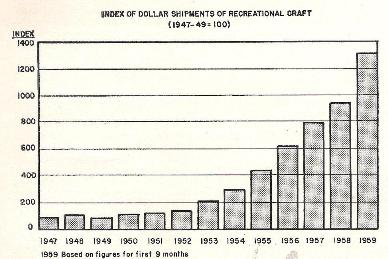
A rapidly growing middle class with more leisure time, a new technology and an exciting sport made wood boat builders with entrepreneurial spirit jump into this new fast growing market. They were problem solving risk takers and many did not make it financially. A glance at this 1947 - 1959 sales chart from the American Engine and Boat Manufacturers, found in a recently acquired copy of Yachting Magazine's 1960 Boat Show issue, explains their enthusiasm. But they built our Dolphin and it is still here today. They are an important, and colorful part of its history.
|
|
Dyke Williams, past owner of Trina, hull #1 of the Bill Shaw designed Shaw 24s, has been following the Dolphin 24 scene for many years. In 2005, he wrote an extensive boat review article for the Sept/Oct issue of Good Old Boat Magazine entitled The Yankee Dolphin. This is required reading for Dolphin owners. Thanks to Dyke and Karen Larson, editor of GOB, you can click here to read it.
|
There were 3 major builders of the Dolphin 24 - O’Day Corporation's subsidiary Marscot Plastics in Fall River, MA, Yankee Yachts in Inglewood, CA, and Pacific Dolphin in Anaheim, CA. In addition, O’Day/Marscot had at least 3 subcontractors, Lunn Laminates in Port Washington/Huntington, NY, F.L. Tripp & Sons in Westport, MA, and J.J. Taylor & Sons in Toronto, Canada.
The number of Dolphins built, and by who, is fairly well established from 1967 on. In the early 1960's O'Day contracted out production of complete boats, as well as supplied kits of parts to boat builders and individuals. How these boats were accounted for is not clear. To find out more about more about this click here. The last known production built boat is the rediscovered Grand Finale, Pacific Dolphin # 300 built in 1978. If the players stayed true to a sequential number scheme that makes 300 boats. Then, in June, 2011, we heard about Monika - click here to see her story.
And, we found out that the Dolphin 24 has a fixed keel cousin, the S&S 24/Falcon 24 built in New Zealand. Approximately 55 boats were built. Click here to read that story.
click here for a complete list of History subjects
**********************
This section is a work in progress and will be updated as new information is received.
|
|