|
| |
|
| Ray Greene and His New Horizons 26 (updated Oct 8, 2011) |
|
| |
|
|
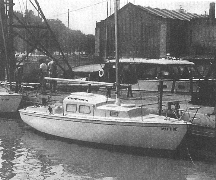
In 1957 Ray Greene commissioned S&S to design for him the New Horizons 26, an all fiberglass boat. pictured at the left. This was to be S&S's first design for a production fiberglass boat. George O'Day and Olin Stephens had their phone conversation on Dec 8, 1958 resulting in Olin's memo to his staff to start design work on the Dolphin (the birth certificate).
George O'Day was committed to fiberglass as the material that would bring boating to large numbers of people. In that December 8, 1958 conversation with Olin Stephens he specifically mentioned the New Horizons 26, along with Trina, the first Shaw 24 and a big winner on the Midget Ocean Racing Club (MORC) racing circuit.
So, these 2 designs, Bill Shaw's Trina, an all wood 24' yawl designed for the MORC rule, and the New Horizons 26, S&S's first production fiberglass boat designed to be an all fiberglass small cruiser, form the parentage of the Dolphin 24. Ray Greene was an important figure, directly and indirectly in the genesis of the Dolphin. |
|
Ray Greene was an early plastic boat pioneer and, if not the first, at least one of the first, production builders of glass reinforced plastic boats.This is a photo of him from the Toledo Blade which I scanned from Dan Spurr's book Heart of Glass, Fiberglass Boats and the Men Who Built Them. Much of what is in this section comes from Dan's book.
Ray lived in Toledo and grew up passionate about boats. In 1929, at 16, he started wood dinghies in his family's garage. Perhaps inspired by his chemist father, his other passion was plastics. While at Ohio State University pursuing mechanical and industrial engineering degrees his research led him to synthetic resins. By the mid 1930s he was building small boats using melamine and urea resins with ordinary cloth for reinforcement.
Owens-Corning Fiberglas was also located in Toledo. In 1941, the company began weaving glass fibers for commercial use and Greene, who had been doing some experimental work for them with rocket tubes, purchased half the initial run of these fibers and built boat models using urea formaldehyde reinforced with glass. During the same period other companies were rushing to develop better resins. In 1942 Ray Greene got his hands on a laboratory produced sample of a polyester cold setting resin and built a dinghy reinforced with glass. |
During the war Ray was a commissioned officer in the navy working on the building of small craft. After the war he returned to his boat building business and in 1947 introduced the Rebel, a 16' fiberglass hull, wood deck day sailer. More than 5000 were built and they are still actively raced. Ray himself was an active racer and winning skipper in the Rebel Class. By 1949 Ray believed he was the largest fiberglass boat builder in the world.
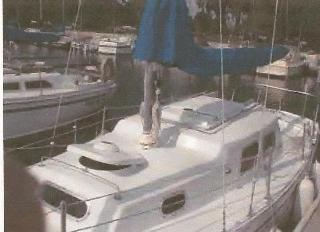 |
Back to the New Horizons 26. There has been some confusion on the name, and length, of the this boat. The actual length is 25'5" and in various places she is referred to both as the New Horizons 25, and the New Horizons 26. One of the objectives Ray Greene had was to make this boat a showcase for what could be done with fiberglass construction. For the same overall length, could be much roomier below, lighter and lower cost than tradtional wood construction, and if properly built be much lower maintence and longer lived. So this boat had many components made of molded fiberglass and minimized interior and interior wood. These boats had molded fiberglass interiors, glass hatches, even the option of fiberglass davits for its fiberglass dinghy. |
|
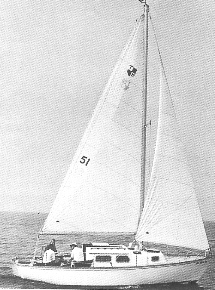
For reasons not altogether clear, the New Horizons 26 project was not well regarded by S&S. It had a good sales spurt after introduction in 1959 but sales fell off sharply after the introduction of S&S's 3rd design for production in fiberglass, the Tartan 27, a 27' designed for Gordon Dougless and Ray McLeod, Jr., founders of Tartan Yachts (shown at left).
Ray Greene was, understandably, not happy with this development. Pictured at the left, the Tartan 27 was very sturdily built, and an excellent sailer, gaining immediate attention and admiration. She was said to be the Dolphin with headroom. Eventually more than 700 would be built. The lead designer at S&S for the Tartan 27, the Dolphin 24, and perhaps even for the New Horizons 26, was Bill Shaw.
|
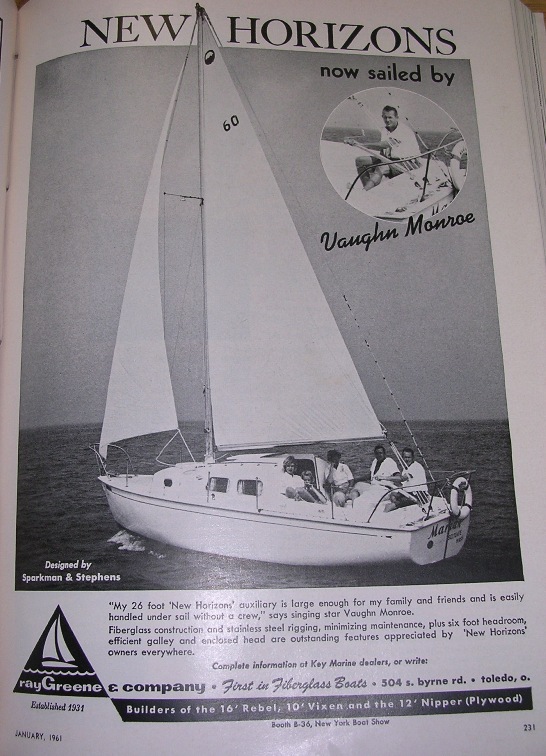
The following is a copy of the ad that appeared in Yachting Magazine's 1961 Boat show issue.
**************************
|
|
| |
|
|