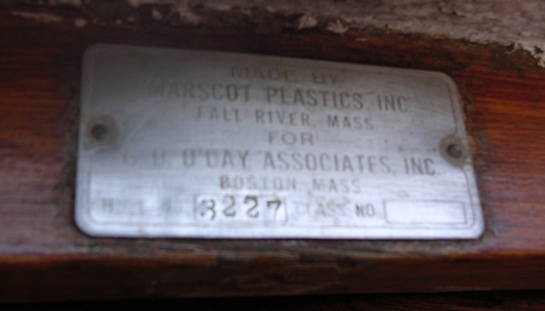
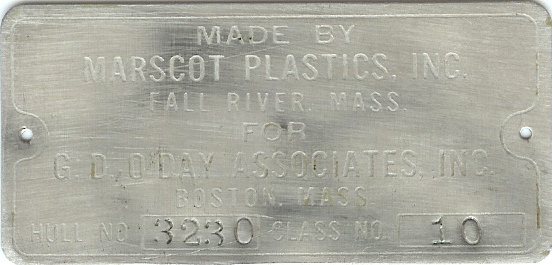
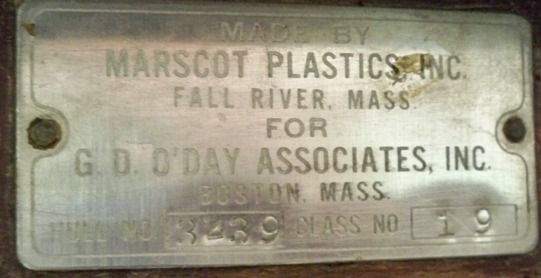
Nameplatology, the study of nameplates, is particularly important to our understanding of who built how many of our Dolphin 24's, and when they built them. The nameplates we find on our boat, if we are lucky enough to have found a nameplate, are major clues to identifying these boats.
The transition from wood to fiberglass in producing larger, off shore capable boats in the late 1950s and early 1960s period introduced high volume, low cost production technology to the industry. Until 1972 there was no standardized method (see below) of identifying any particular boat. The early years of Dolphin 24 production saw at least 5 'builders', ostensibly under the control of G. D. O'Day Associates and its various affiliates. This company did not leave a clear method of identifying these boats, nor any record of exactly how many boats they built. Nevertheless, an attempt to establish how exactly many Dolphins were built by O'Day and its sub contractors, and by Yankee and Pacific Dolphin, was made in another section - the Number of Dolphins Built, and by Whom - click here to go there.
Here, in this section, we apply the fuzzy principles of Nameplatology to try find, and understand, Dolphin 24 nameplates, and thereby help illuminate the early days of the Dolphin, and help identify our own specific boats..
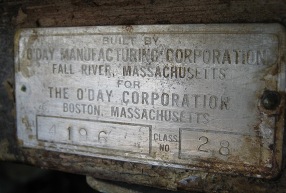
Shane Walden, previous owner of Tiki, O'Day #28, sent in this photo of Tiki's nameplate. This is an interesting plate because it shows the corporate entity transition from Marscot Plastics, Inc. in Fall River, MA building for G. D. O'Day Associates, Inc. Boston, MA to O'Day Manufacturing Corporation, Fall River, MA building for the O'Day Corporation, Boston, MA. Marscot's corporate entity was absorbed into O'Day Corporation. Note that the first box has the number (4)196 (On June 19, 2009 Jim confirmed that there is a light 4 in front of the 196) If the first box is a sequential "all boats built" number system Marscot/O'Day built 957 boats in the time period that they built a total of 9 Dolphins. Possible?
Bob Larson, one of the early investors in O'Day told your webmaster that Palmer Scott swapped his Marscot Plastics company for shares in the O'Day Corporation about this time.
We do not have a photo of Stan Barnes' Shamon nameplate but we know he bought it new in November 13, 1960 from a dealer in Mamaroneck, NY for $6400.90 (he still has the check stub. Stan says his hull # was 25 and he had that number put on his mainsail.
Tony Petrillo, former owner and restorer of Gem (now Bodes Well), says her number is 29, and that she was built in 1960.
This is Don Barnett's Casandra Rose's nameplate
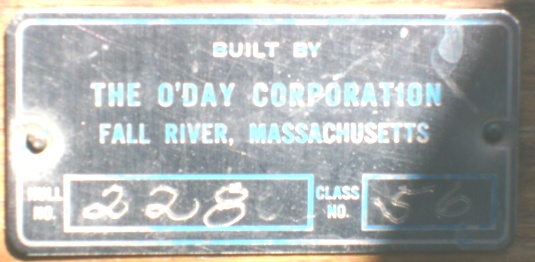
Casandra Rose is Hull # 56. Following some of the logic above, 228?, if that is the full number (I see the outlines of a zero? following the 8), would be the sequential production number. Casandra Rose is almost certainly # 56. Tiki is almost certainly # 28. That's a 28 boat 'Dolphins built' difference. We know of only one boat, Bodes Well, reportedly hull # 29, in this range.
Casandra Rose's 'sequential # is 228? Maybe with the corporate change they started a new sequential listing of hulls? Tiki's is (4)196?
About this time, perhaps, Marscot/O'Day had their fire and contracted 25 boats to be built by Lunn - there is an unexplained gap in hull numbers between #29 and # 56. Maybe this is where Lunn's production is accommodated?
This is where we are at June 18, 2009. The Marscot/O'Day nameplates seem to indicate the actual hull # in their nameplate box titled CLASS NO. The HULL # nameplate box seems to indicate some type of sequential production series number, perhaps inclusive of all boats produced at that plant. The corporate change from Marscot to O'Day may have had some influence on this system.
Our theory clearly needs more work but we will continue to follow the scientific method - concoct theories that fit the available evidence.
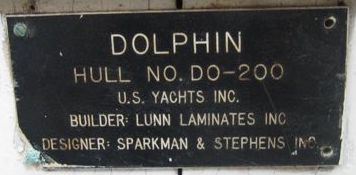
This is the nameplate on Gary Delong's Savili, presumably the first boat built by O'Day's first sub contractor, Lunn Laminates. (We say presumably because we have an interesting side story about the, or another, first boat that Lunn built - It is on the US Yachts page - click to go there). Note that G. D. O'Day Associates, Inc., or O'Day Corporation, does not appear on the nameplate. US Yachts was formed in late 1960 as the the sales and marketing agent for the Dolphin. Reportedly, the fire at the Marscot plant in Fall River in the late Fall? of 1960 led to Lunn being given a contract to build 25 Dolphins, and they were instructed to start their hull numbering series with the number 200.
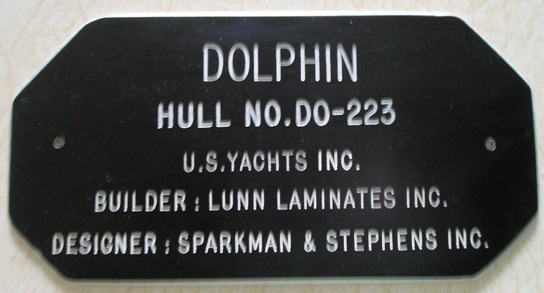
This is the nameplate that Lunn Laminates of Port Washington, NY affixed to Louis Claassan's Spirit of Fellowship.
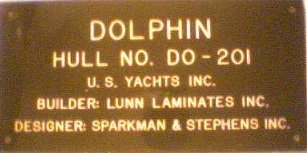
The above nameplate is an an interesting anecdote. Lunn model makers apparently made 1/10 scale models of the Dolphin that owners bought or received with their boat. Roy Berg, the former chief engineer of Lunn, and 1st owner of Black Dolphin, Lunn Hull # 219, assembled one of these models. Son Doug took a picture of this model recently and sent in the above photo of the nameplate that is on that model. Note that the hull # is 201. I'll bet there is a story here...
Doug Berg also sent in an old picture that shows the location of the nameplate on his family's boat, Black Dolphin. Unlike the Marscot/O'Day built Dolphins, it was on the main bulkhead, facing aft.
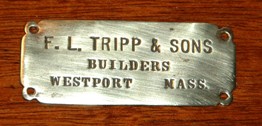
This is the nameplate that Jay Picotte's Recovery has - it does not help us with hull numbers. It may be that the 4-5 boats built by Tripp for O'Day actually were accounted for in the O'Day hull number system.
As yet, we do not have a sample J. J. Taylor & Sons nameplates - or even know if they had them.
This ends, we think, the era of Dolphins built on the east coast, and probably the need for sophisticated nameplatology. Both Yankee and Pacific Dolphin had comprehensible hull numbering systems. Here is Yankee's
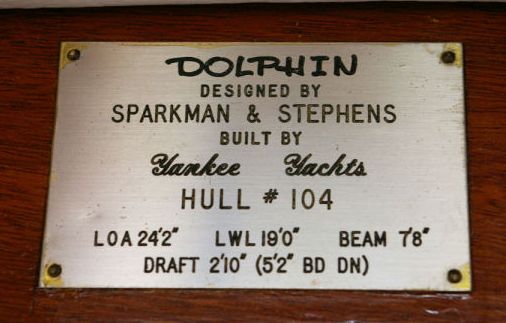
This is Feather's, Yankee #104's, nameplate. Yankee placed their nameplates on the main bulkhead arch facing aft
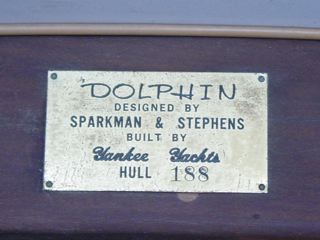
This is the nameplate that Eric Varty found on his Canopache, Yankee hull # 188.
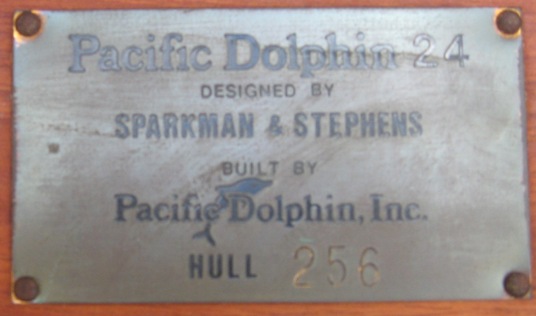
This is Kevin O'Leary's Delphinidae's nameplate, Hull # 256. Note the Dolphin arcing between the words Pacific and Dolphin.
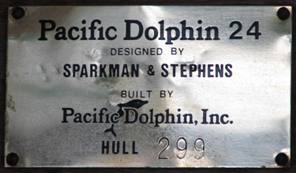
This is the nameplate from Richard Mc Connell's Fire Escape, Pacific Dolphin # 299.
In 1972 boat builders in the US were required to mold or permanently affix identifying information on the transoms. These were known as HIN #s (See following article) According to Paul Ingle, his Pacific Dolphin Seminole has the following HIN # number stamped on his transom PDM2840577. Using the information provided by Steve Henkel in the article below this would mean PDM = Pacific Dolphin Marine; 284 = Hull number, 0577 = May, 1977. In the Dolphin 24 game, and failing to find a classic nameplate like those above, this Hull # is the kind of number we want to find.
********************************
Here's some useful information from Steve Henkel's book, Boating for Less: How to Save Money When Buying, Owning and Selling Your Power or Sail Boat. This book is a great resource for sailors. International Marine is the publisher. The second edition came out in 1992.
" The hull identification number (HIN), stamped on a tag or molded into the transom of boats built after November 1972, is generally a series of 12 letters and numbers as set up by the U.S. Coast Guard. Henkel's example: ZTYSR384A787. He says that some manufacturers did not follow the prescribed code exactly. For those that did, here's how it works:
ZTY -- This is a code for the manufacturer. CHL means Cheoy Lee. SSU means S2 Yachts. ZTY means Ontario Yachts. SR384 --The next five characters denote the model identification and production number of the specific boat in the series. SR384 stands for Sonar 384. A7 -- These two characters indicate month and year of the Coast Guard certification of the model. The letters A-L designate the months January through December. The numbers indicate the last digit of the year of certification. (This could be a bit confusing for those whose boats which may have been built either in the 1970s or 1980s, for example. It appears that no one expected them to hold up so well for so long. Fortunately the next set of numbers will probably clarify it for you.) The boat in the example would have been certified in January 1987. 87 -- These last two characters indicate the last two digits of the model year, which Henkel says normally runs from August 1 through July 31. In the example, the model year runs from January through December.
Henkel says this information may come in handy when you¹re buying a boat that seems older than the seller says it is. If you don¹t have a clue about your boat, it may also come in handy, since it will give you a few important hints. He also notes that the engine serial number on an inboard engine is usually stamped on the block and may also appear on a tag on top of the transmission or elsewhere. The serial number on outboards is usually stamped on a plate riveted to the stern bracket."
************************
Patience...